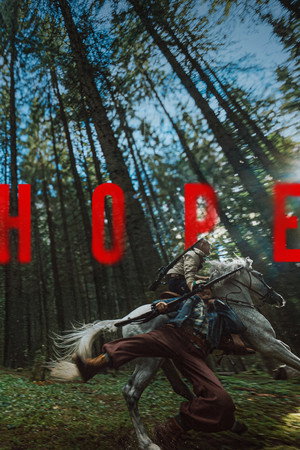
In the remote South Korean village of Hope Harbor, police chief Bum-seok and officer Sung-ae are called to investigate a mysterious creature wreaking havoc on the community. But all is not as it seems, and perceptions can be misleading. What begins as ignorance plants the seed of disaster, escalating through human conflict into a tragedy of cosmic proportions.
police chief police officer hunted remote village aliens 20th century grand exhilarated fight for survival unknown entity
A private user reviewed Hope (2026)
Hope
An old saying maintains “Never put the cart before the horse,” an observation whose implications should be obvious. That applies in filmmaking, too: When a standalone production is thought to be the inspiration for a new franchise, the creators need to be careful not to get ahead of themselves. That’s to say that the first film in the proposed series absolutely must be a knock-out to earn the right to a sequel (or sequels) (“Star Trek” notwithstanding). But, if those behind the initial effort are so focused on what lies down the road in a potential franchise that they don’t get the first release right, it’s the equivalent of shooting themselves in the foot. And that is precisely what undermines this latest release from writer-director Na Hing-jin. In essence, this sci-fi action-adventure follows the improbable, occasionally strangely madcap attempts by a small town South Korean police force and others to hunt down a mysterious monster that’s wreaking all manner of havoc in their community and the surrounding environment. The problem, though, is that little is explained as the story unfolds, with an array of tropes that seem unconscionably thrown together – virtually no back story, a disjointed, poorly constructed narrative, woefully cheap CGI, a plot based almost entirely on clichés, frenetic action sequences, and absurd, sometimes patently inappropriate comic relief, and more overused expletives than seen in “The Wolf of Wall Street” (2013). While the film admittedly gets off to a reasonably well-managed start, coming across as a fusion between the “Godzilla” movies and the folksy, homespun nature of “Fargo” (1996), it’s an opening act that’s ultimately unforgivably drawn out (building suspense is one thing, but knowing that a big reveal is coming and taking 45 minutes to get there is a bit much). And, sadly, things go downhill from there, with a story that makes little sense stretched out to a stunning 2:39:00 runtime, overstaying its welcome by nearly an hour. My only “hope” for the picture at that point was that it was mercifully heading to wrap things up with some kind of coherent explanation that, unfortunately, never comes. And that’s where the focus of what’s to be included in future franchise installments intrudes upon the credibility and integrity of this release. What’s even more mystifying here is the high praise that this overlong saga has received both in critics’ circles and at the prestigious Cannes Film Festival, where “Hope” was inexplicably awarded a Palme d’Or nomination, the event’s highest honor. Moviegoers looking for entertaining scary fare along these lines have so many other, better choices to draw from, such as “Jaws” (1975), “Jurassic Park” (1993) and the recently released “The End of Oak Street” (2026). Please, watch one of those titles instead.

OR
Enter your username and email (the password will be emailed to you):